To find out whether a paint plant uses chemicals on a regulated list, check against the Decree 24 chemical list: Decree 24/2026/ND-CP was issued on 17 January 2026, took effect on the date of signing, and sets out four chemical lists, and some solvents such as toluene, xylene and methanol are named in Appendix I. The plant needs to review the raw materials it uses against all four appendices to see which lists it is connected to.
What paint plants need to know about Decree 24/2026/ND-CP
Decree 24/2026/ND-CP is the chemical list under the Law on Chemicals: it names the chemicals to which the provisions of the Law on Chemicals apply (Article 1). Its full title is the Decree on the chemical lists within the scope of the Law on Chemicals. The decree only issues the lists; Articles 1 to 5 set no specific obligations for enterprises.
The Government issued the decree in Hanoi on 17 January 2026, signed by Deputy Prime Minister Bùi Thanh Sơn. It takes effect from the date of signing (Article 4), that is, 17 January 2026. The full text has no transitional provisions and does not name any document that is replaced, repealed or amended.
Article 1 states that the decree serves three areas: development of the chemical industry, chemical activities, and safety and security in chemical activities. The decree is tied to four provisions of the Law on Chemicals: Article 6 clause 2, Article 9 clause 1 point a, Article 9 clause 2 point a, and Article 37 clause 2. Article 2 applies to domestic agencies, organisations and individuals, and to foreign organisations and individuals, with activities related to those areas in Vietnam. The document does not single out the paint industry.
The problem lies on the plant's side. A paint shop uses resins, solvents, pigments, fillers and additives at the same time, and each has several sources of supply. Without a cross-check, the technical and purchasing teams do not know which chemicals sit in which list. The decree does not require enterprises to cross-check; reviewing raw materials is a way for the plant to know which parts of the document and of the Law on Chemicals it needs to read.
How the four appendices of the Decree 24 chemical list are arranged
Article 3 sets out four lists, placed in four appendices attached to the decree:
- Appendix I: list of basic chemicals in the key chemical industry.
- Appendix II: list of chemicals subject to conditional production and trading.
- Appendix III: list of chemicals subject to special control.
- Appendix IV: list of chemicals that require a chemical incident prevention and response plan.
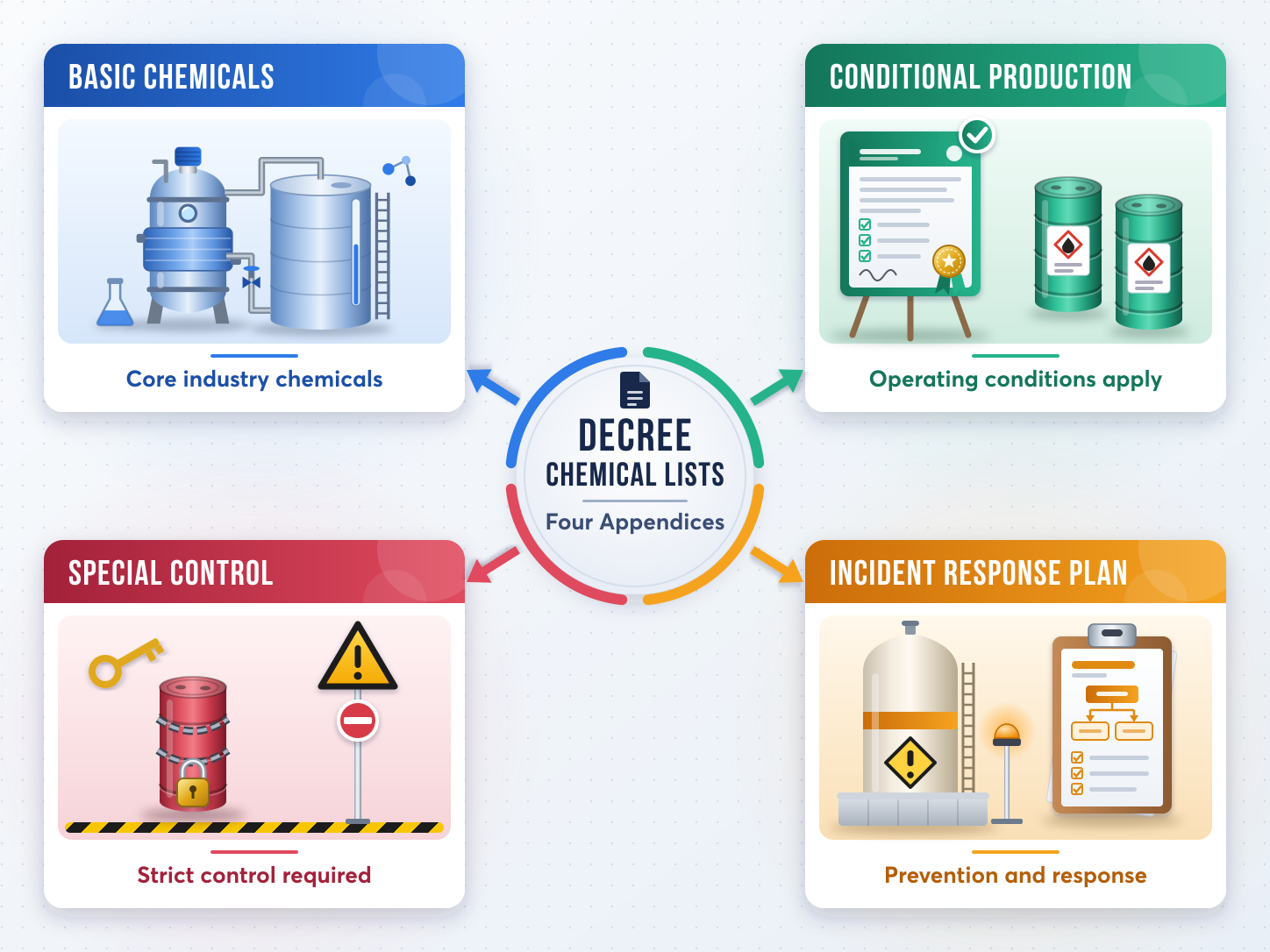
The arrangement follows the regulatory purpose of each list. The group of basic chemicals sits in Appendix I; the other three appendices relate to trading conditions, special control and incident response. The specific conditions for each group are not in this decree.
The structure of each appendix determines how to look things up:
- Appendix I is a table with these columns: serial number, scientific name (IUPAC nomenclature), substance name, CAS number and chemical formula. A few rows are "chemical groups", so the CAS number and formula columns read "—".
- Appendix II has two parts. Part 1 is a table of substances subject to conditional production and trading, with five columns as in Appendix I. Part 2 covers mixtures of such substances, set out in words with content levels by mass.
- Appendix III has two parts. Part I covers specially controlled substances, divided into Group 1 and Group 2, each with a five-column table, with sub-items such as industrial precursors, chemicals under the chemical weapons convention, chemicals under international chemical conventions, and "Other chemicals". Part II covers mixtures, set out in words with content levels.
- Appendix IV has two tables. Table A is the list of substances, with an additional column for the maximum storage mass at any one time. Table B lists hazard groups under GHS classification (the Globally Harmonized System of Classification and Labelling of Chemicals), with mass thresholds. The appendix applies to substances in Table A and to mixtures containing a Table A substance that fall under a Table B case when classified under GHS.
The tables list chemicals by scientific name, substance name, CAS number and formula, so the plant can look up any of these details. What to remember is to check several appendices: one substance name can appear in Appendix I and also in Appendix III or Appendix IV, so checking one table is not enough. Mixtures have their own rules. For example, Appendix III states that a mixture whose components belong to both the conditional production and trading list (Appendix II) and the special control list (Appendix III) is treated as a specially controlled mixture (Appendix III, part II).
The specific obligations of each appendix are not in the decree: the production and trading conditions, how special control works, the content of the incident response plan, and the role of the basic chemicals list. These matters are in the Law on Chemicals and related documents, so the plant needs to read the source documents directly rather than infer from the appendix titles.
What determines how a paint plant cross-checks the chemical list
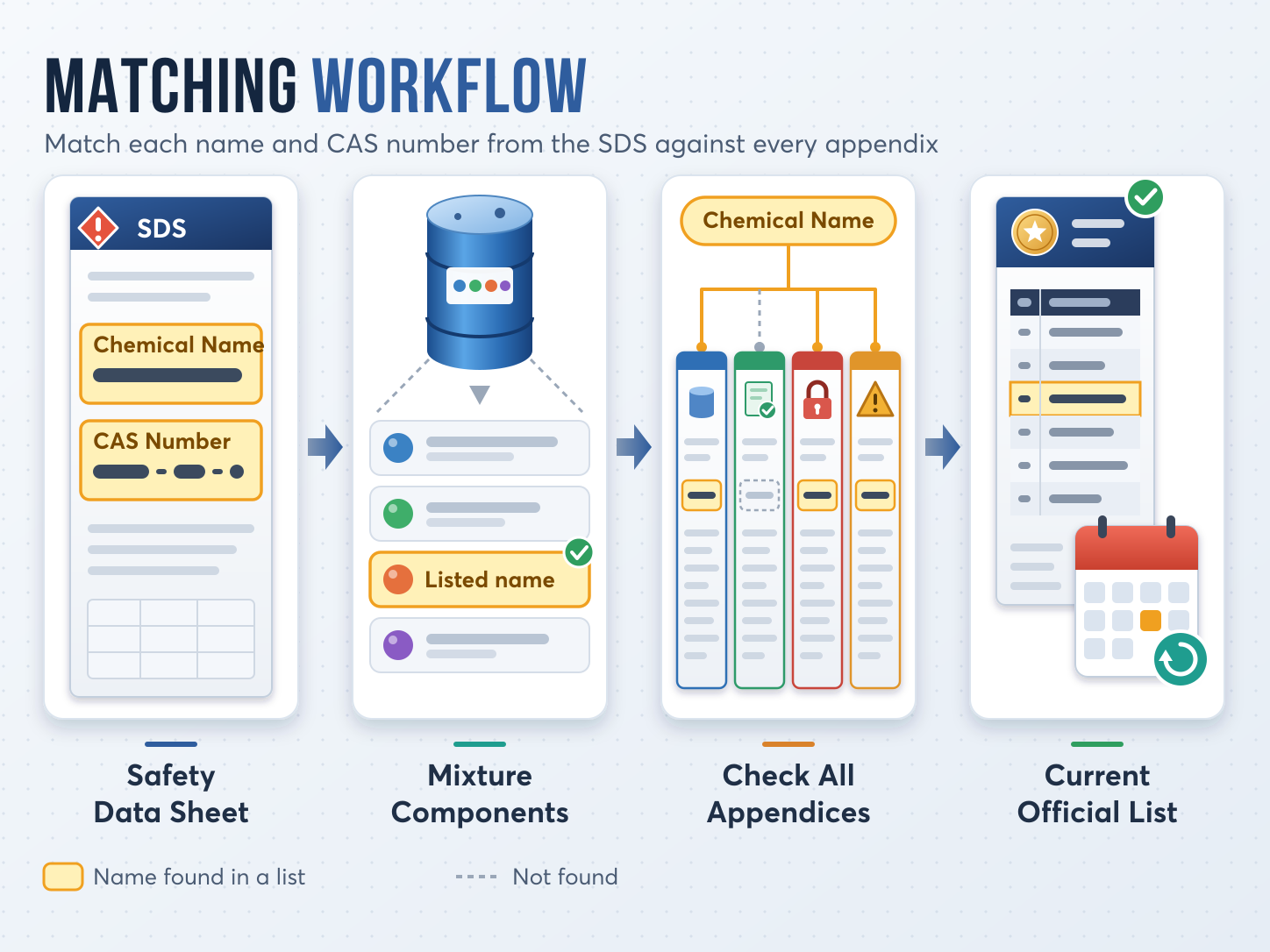
A plant can run the cross-check when it has three things: a raw material list under the correct chemical names, the composition of each mixture, and the in-force version of the list.
Raw material list: the appendix tables are built on the IUPAC scientific name, substance name and CAS number, not on trade names. So build the list by chemical name or CAS number. The safety data sheet (SDS) of each raw material is where these two details are usually stated for lookup. The decree does not mention the SDS; this is a practical way to look things up.
Mixtures: many raw materials a paint plant buys are mixtures. The decree has separate provisions for mixtures in Appendix II (part 2), Appendix III (part II) and Appendix IV (the opening paragraph and Table B). A mixture is assessed by the components it contains from the list, by content level or by GHS classification; read the specific level in each appendix. The composition in the SDS shows whether a mixture contains a substance named in the list. The decree does not designate the SDS as the basis, so names and CAS numbers need to be matched against the appendices.
Timing: the decree takes effect from the date of signing (Article 4), has no transitional provisions and sets no deadline for enterprises to cross-check. The plant should cross-check now, without waiting: knowing early which lists it is connected to leaves time to read the related documents before they are needed.
List version: ministries and ministerial-level agencies review, propose adjustments to and update the lists periodically before 30 June each year, and send them to the Ministry of Industry and Trade. The Ministry of Industry and Trade assesses the impact, consolidates the proposals and reports to the Government for consideration and decision (Article 5 clause 2). The lists can change, so each cross-check should use the in-force version from an official source.
When a paint plant needs to cross-check the list and when it does not yet
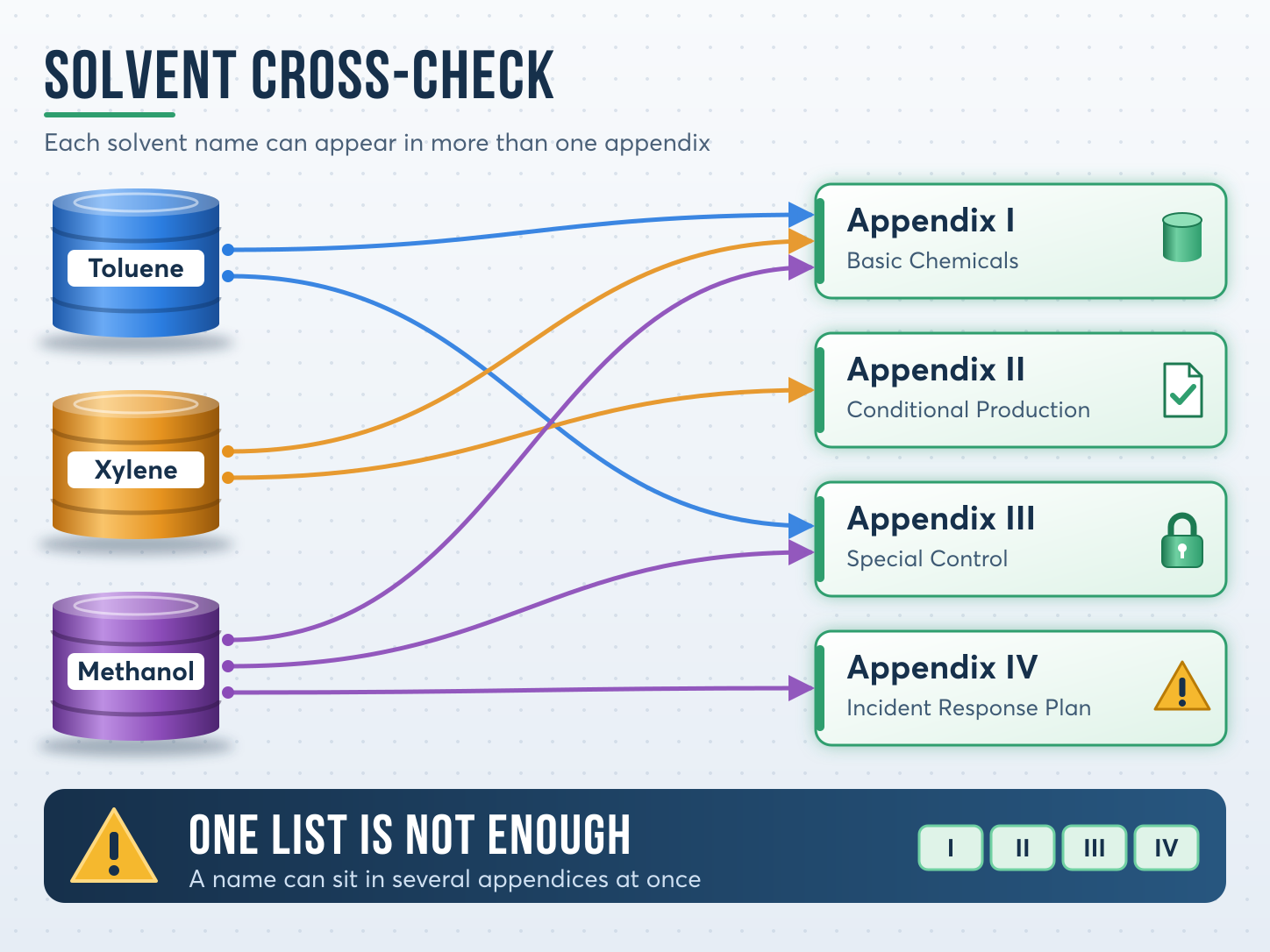
A paint plant needs to cross-check when its warehouse holds solvents such as toluene, xylene or methanol, because all three are named in Appendix I (the substance names in the table are Toluene, Xylen and Metanol). This is the clearest starting point for blending and thinning lines.
These three solvents also appear in other appendices: toluene in Appendix III, xylene in Appendix II, and methanol in Appendix III and Appendix IV (Table A). So checking one appendix is not enough. The decree does not state any conditions or obligations attached to these names.
Cross-check again when you change raw material sources and when you add a new chemical to a formulation. The decree does not regulate these two situations; they are the points at which the raw material list changes, so the cross-check list needs to be updated with it. Changing raw materials usually comes from a formulation problem: when the plant follows guidance on how to fix solvent-based paint that sags after thinning, applies how to fix pigment-based printing ink that settles in storage, or considers how to choose TiO2 for packaging printing ink, the raw material composition may differ from before and needs to be checked again.
The cross-check result is an identification step: it only shows which list a chemical is named in. Any further obligations should be read in the Law on Chemicals and related documents, not inferred from the fact that a chemical is named in a list.
The decree does not state any case in which an enterprise "does not yet have to" cross-check. If a raw material has been cross-checked and is not named in any list, this decree has no basis to place that material in a list. This is an inference from the structure of the text, not a regulation.
Frequently asked questions
When does Decree 24/2026/ND-CP take effect?
The decree takes effect from the date of signing (Article 4). The issue date on the document is 17 January 2026, so that is also the effective date. The document has no transitional provisions and states no period for enterprises to adapt.
Are toluene and xylene in the Decree 24 chemical list?
Yes. Both toluene and xylene are named in Appendix I, the list of basic chemicals in the key chemical industry. These two substances also appear in other appendices: toluene in Appendix III, xylene in Appendix II. The attached obligations are not in the decree.
Which appendices does Decree 24 of 2026 contain?
Four appendices under Article 3: Appendix I covers basic chemicals in the key chemical industry; Appendix II covers chemicals subject to conditional production and trading; Appendix III covers chemicals subject to special control; Appendix IV covers chemicals that require an incident prevention and response plan.
Conclusion
Decree 24/2026/ND-CP sets four chemical lists. A paint plant learns which lists it is connected to by cross-checking each raw material by chemical name or CAS number, then reading the source document and related documents for further obligations.
- Decree 24/2026/ND-CP was issued and took effect on 17 January 2026 (Article 4).
- There are four appendices (Article 3); cross-check raw materials against all four, because one chemical can be named in several appendices.
- Toluene, xylene and methanol are named in Appendix I.
- Mixtures have their own rules in the appendices; the lists are reviewed every year, so use the in-force version.
If you need the SDS of each raw material lot to look up chemical names and CAS numbers against the four appendices, please send a request so the Vichem technical team can assist.
Vichem is a distributor of chemical additives and equipment from leading brands such as Covestro, Sinopec, TotalEnergies Corbion, Bühler and Tinox in the Vietnamese market.
For more information about our products, please contact us through the following channels:
- Hotline: 08 1790 1790
- Zalo OA: Vichem JSC
- Email: contact@vichem.vn
- LinkedIn: Vichem JSC
- Website: www.vichem.vn
- Facebook: Vichem JSC