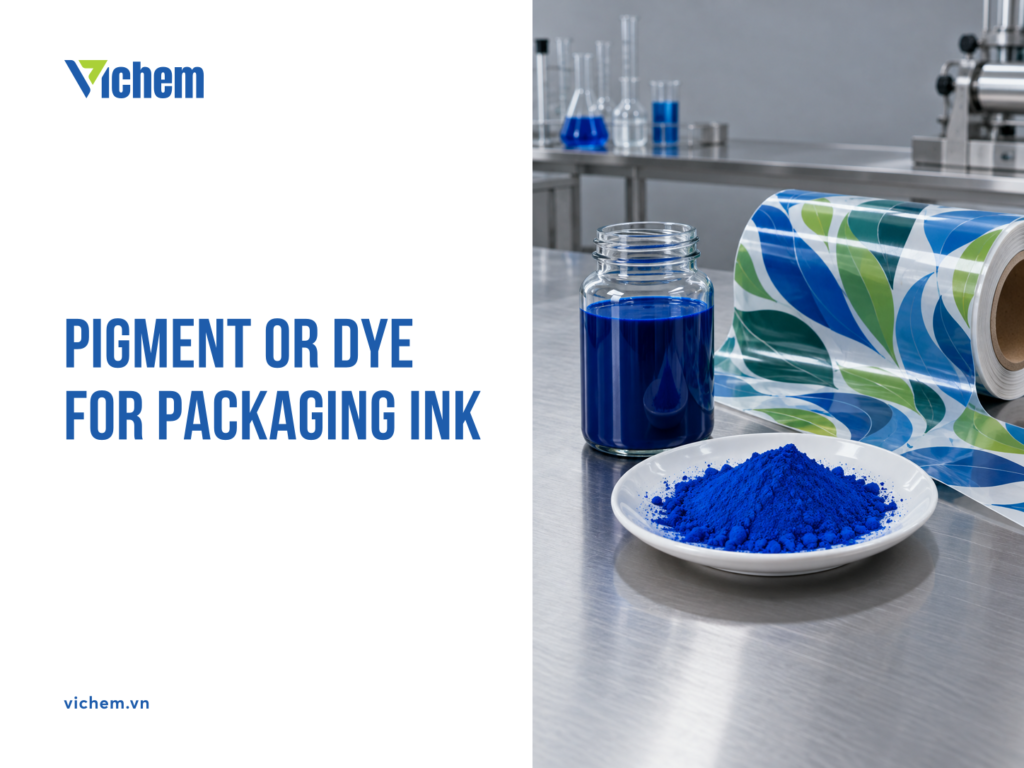
Pigments for printing inks are usually the main choice for packaging, because insoluble particles hold color better under light, migrate less and resist solvents better than dyes dissolved in the ink. Dyes suit only applications that need transparency and brightness on a clear substrate with low fastness requirements. Three conditions decide the choice: the fastness requirements of the package, the level of food contact, and the substrate being printed.
Where packaging fails when the wrong colorant is chosen
The colorant decides whether a package still meets requirements after it leaves the printing line. Errors from a wrong choice often show up only after the goods are in the warehouse, on the shelf or with the brand owner, when the cost of handling them is already high.
Common failure modes:
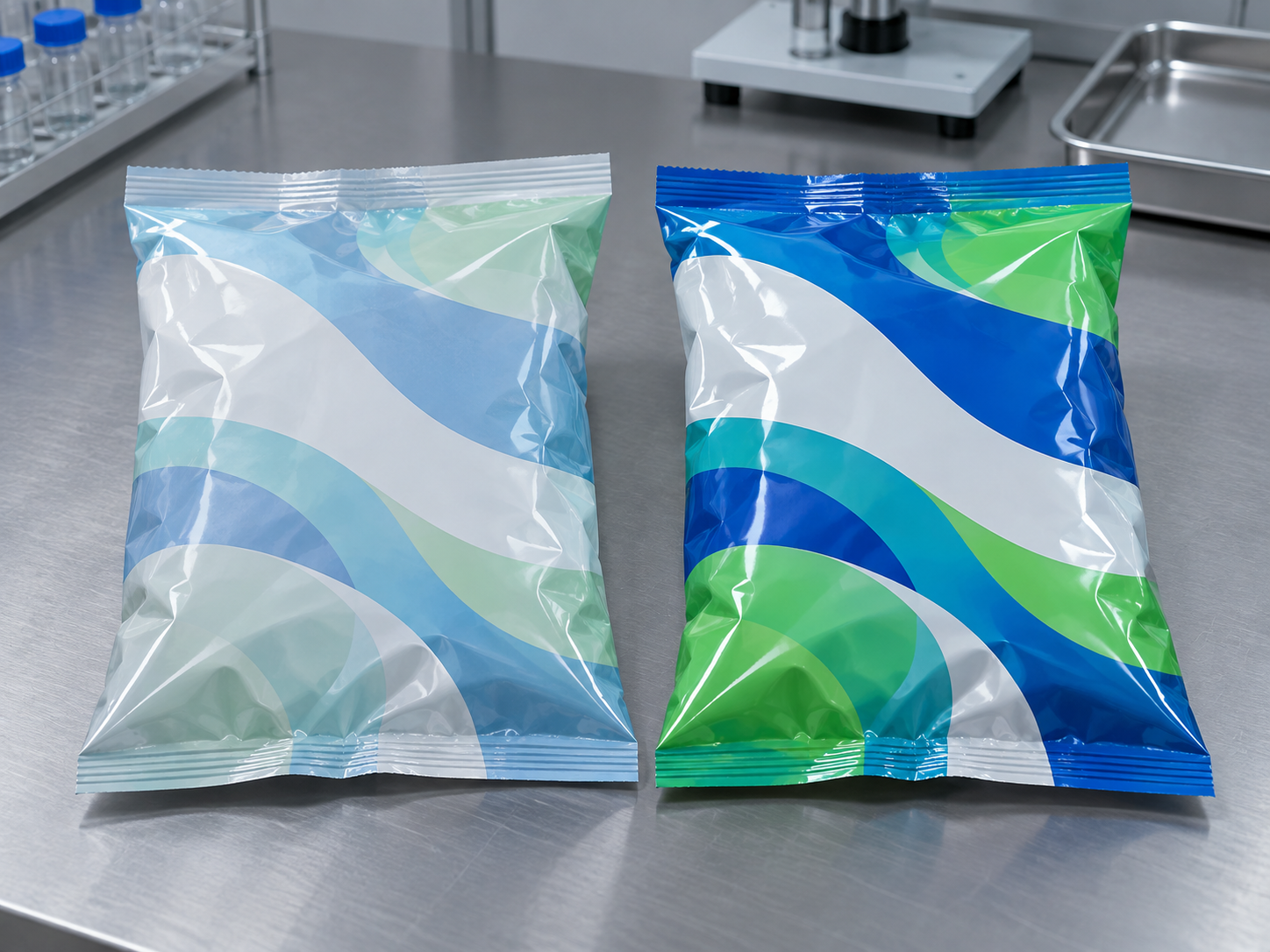
- Fading on the shelf: packaging exposed to store lighting or sunlight through glass fades gradually and shifts in tone against the approved sample.
- Migration: the colorant moves from the ink layer into the laminating layer, the inner face of the package or the food. Color bleeding at the lamination edge is the earliest visible sign.
- Bleeding on contact with oil or alcohol: packaging for oily food, or wiped with an alcohol-based solution, smears color onto the contact surface.
- Failing export packaging requirements: overseas customers often require documentation on the colorant and heavy metal compliance. A colorant without documentation gets the shipment held or returned.
All four failures come from the same difference in the state of the colorant in the ink. Pigments are insoluble in the binder and solvent, and exist as solid particles dispersed evenly in the ink film. Dyes dissolve completely in the ink medium, exist at the molecular level and have no particle boundary.
This difference determines how the colorant reacts to light, heat and solvents, and whether it can move within the film. The criteria in the next section all trace back to this point. Ink manufacturers need to understand it before choosing raw materials, because correcting a formulation after the customer has approved the sample always takes far longer than choosing correctly from the start.
4 criteria for choosing between pigment and dye
The four criteria below cover most cases. They should be weighed in the priority order of each application, because no colorant meets all of them at once.
Light and heat fastness
Light, especially UV, breaks bonds in the chromophore structure. In a pigment, molecules are arranged in a crystal lattice inside the particle. The outer layer of molecules takes the impact first, while the inside of the particle is shielded, so color is lost more slowly.
Dissolved dye molecules sit individually in the ink film. Each molecule is directly exposed to light and oxygen with no shielding, so they degrade faster. The same principle applies to heat: crystals are more heat-stable than dissolved molecules, which matters in ink drying and lamination.
The specific fastness level depends on each pigment and is given in the supplier's TDS. Read it together with the test conditions stated in the document.
Migration and solvent resistance
Dissolved substances can diffuse through polymer films, laminating adhesive layers and contact zones. Dyes therefore carry a higher risk of migration. Insoluble pigment particles are large compared with molecules, so they migrate through films with difficulty and are hard for solvents to carry away.
This is especially important for food packaging, where colorant bleeding into the contact layer is a safety risk, not just an aesthetic one. Solvent resistance follows the same logic: solvents can dissolve dyes, while pigments are affected only when the particle structure has some solubility in a specific solvent. Pigments still need to be tested with the exact solvent and laminating layer of the running system.
Transparency, brightness and opacity
This is the criterion where dyes have the advantage. Dissolved molecules do not scatter light, so the ink film is transparent and bright, suited to inks printed on clear film where the color must be seen through.
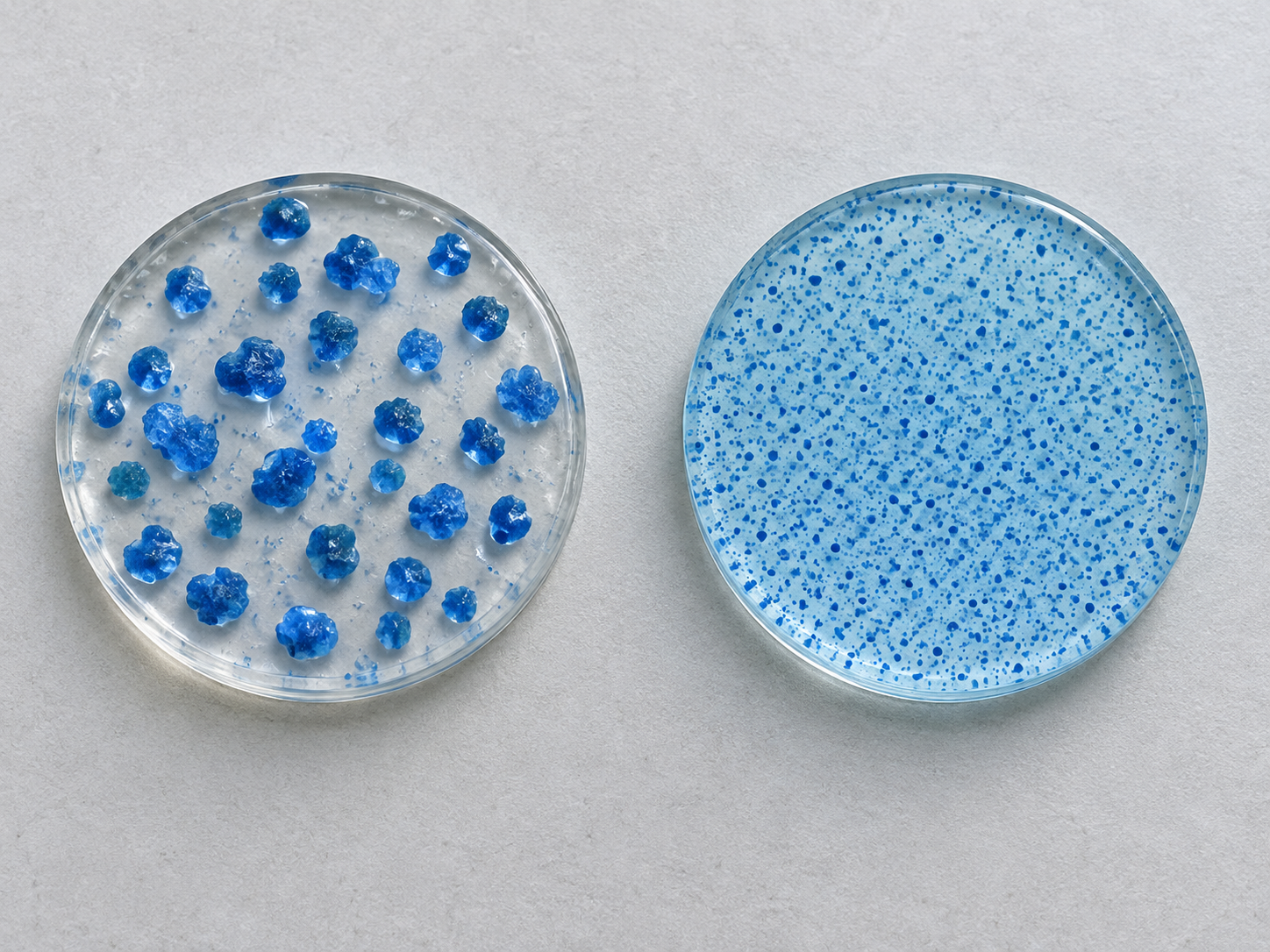
Pigment particles scatter and absorb light, so the ink film tends to be more opaque and has hiding power. Particle size governs the result: the finer the particles and the narrower the distribution, the clearer the film and the cleaner the color; coarse particles dull the color and reduce gloss. To get a transparent ink while still using a pigment, choose a fine-particle grade and make sure the dispersion step reaches that fineness.
High opacity helps when printing on a colored substrate or when the layer underneath must be covered. In that case the scattering property of the pigment is an advantage.
Dispersibility and ink stability
Dyes dissolve, so they need no dispersion. Pigments are the opposite: the particles must be wetted, separated from agglomerates and kept stable in the ink. Poor dispersion leads to weak color, particle streaks on the print surface, viscosity changes, and settling or flocculation in storage.
How hard a pigment is to disperse varies with the particle surface and with the resin and solvent system of the ink. Choosing a pigment therefore has to go together with choosing the dispersion system and milling process, not stop at choosing the color.
This is the technical cost an ink manufacturer must account for when giving up dyes, in return for higher fastness.
How to match the choice to your packaging ink
The three steps below go from the packaging requirements to the parameters to read in the technical documents.
Step 1 — Define the end-use requirements
Start from where the package will be used, since this sets the fastness level needed:
- Food packaging: prioritize low migration and clear compliance documentation. Confirmation that the colorant meets the regulations of the target market may also be required.
- Outdoor or long-term display: prioritize light fastness.
- Sterilization or heating: prioritize heat resistance, since the colorant must go through the heat cycle without changing tone.
- Lamination: the ink layer sits between two materials, so it needs resistance to solvents from the adhesive layer and limited migration into the adjacent layer.
Step 2 — Define the ink system and substrate
The ink system determines the environment the colorant must live in. Solvent-based, water-based and UV inks differ in binder, polarity and curing method. The pigment must be compatible and disperse stably in that exact system, and the stabilizer on the particle surface must suit the system.
The substrate also affects the choice. Clear film needs transparent or overprint inks, so transparency and particle size become priorities. A white substrate allows moderate opacity and makes it easier for general-purpose pigments to meet requirements.
Step 3 — Choose the pigment type and the parameters to read on the TDS
Once the requirements and ink system are clear, choose between organic pigments and inorganic pigments, then check the TDS against the following parameters:
- Light fastness and heat resistance, with the test conditions.
- Solvent resistance, checked against the solvent in the ink system and the laminating adhesive.
- Particle size and particle distribution, especially when a transparent ink is needed.
- Heavy metal compliance, for which separate documentation for each shipment should be requested.
Organic and inorganic pigments can be sourced from Hangzhou Zealan Chemical, among others. Request the TDS and trial samples, then have the lab run a trial on the exact ink system and substrate before approval.
Common mistakes when choosing colorants for packaging inks
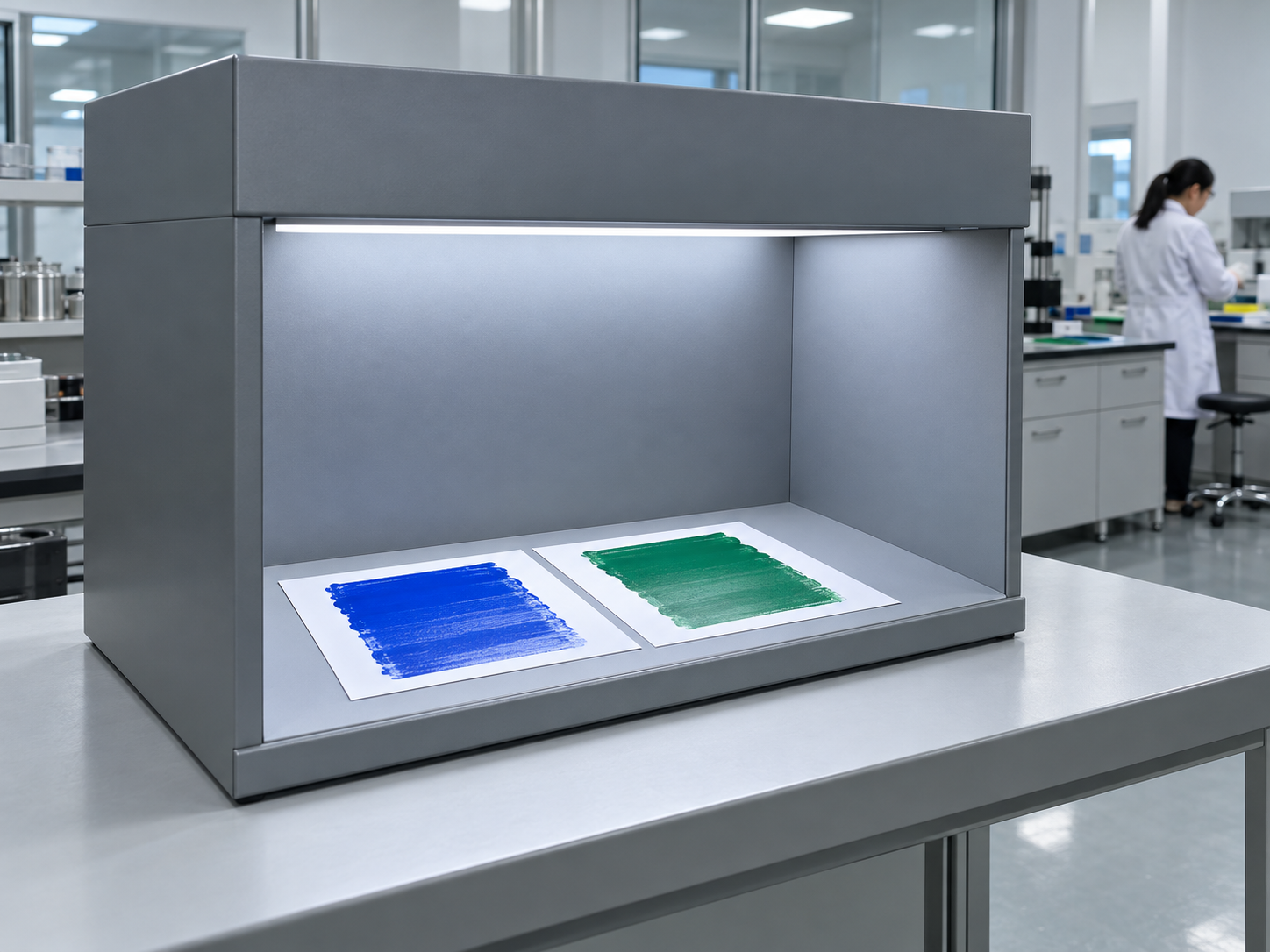
Choosing by the brightness of the first sample. Dye samples are often brighter and more transparent, so they win easily at color approval. After a few weeks of light exposure or solvent contact, their limitations show. Put samples through fastness testing before deciding.
Ignoring migration. An ink that looks fine when freshly printed can still have colorant moving into another layer after storage. For food packaging, migration must be considered from the raw material selection stage.
Using a hard-to-disperse pigment without adjusting the dispersion system. A pigment put into an ink system with the dispersant and milling process of another pigment gives weak color, particle streaks and settled ink. When changing pigments, review the dispersant, milling time and the fineness achieved.
Not requesting heavy metal documentation. Colorants, especially inorganic ones, may contain heavy metals depending on the source. Without documentation it is hard to respond when customers or brand owners audit, especially for export goods. Request the compliance documents together with the TDS and SDS for each shipment.
Frequently asked questions
What is the difference between pigment inks and dye inks?
Pigment inks contain insoluble pigment particles dispersed in the binder. Dye inks contain dyes fully dissolved at the molecular level. Pigment inks usually have better light fastness and solvent resistance, while dye inks give clearer, brighter color. Pigment systems need an extra dispersion step; dye systems do not.
Should food packaging use pigments or dyes?
Pigments should usually be preferred, because insoluble particles migrate through films less readily than dissolved substances. Even so, the final decision also depends on the type of food, the barrier layer between ink and food, and the regulations of the target market. Request the colorant's compliance documents and test migration on the actual packaging structure.
Why do packaging inks fade?
The root cause is that the chromophore structure is broken down by light and oxygen. Dissolved dyes are more prone to it because every molecule is exposed. A colorant with low light fastness for the conditions of use, or an ink layer made thin by poor dispersion, also fades faster. Check the fastness on the TDS against the real environment.
Organic or inorganic pigments for printing inks?
Neither type is right for every case. Organic pigments give clean, bright color and a wide color range, while inorganic pigments usually have good opacity and high heat resistance. Choose according to the end requirements of the package, the ink system and heavy metal documentation. Both types need testing in the real ink system.
Conclusion
For packaging inks, pigments are the default choice when the package must hold color for a long time, resist migration and withstand solvents. Dyes play a narrow role, for applications that put transparency and brightness ahead of fastness. The decision should rest on the end-use requirements, the ink system, the substrate and the colorant documentation.
- Weigh four criteria: light and heat fastness, migration and solvent resistance, transparency and opacity, dispersibility.
- Read the TDS for fastness, solvent resistance and particle size, and request heavy metal documentation for each shipment.
- When switching to a pigment, review the dispersion system and milling process.
- Exception for dyes: transparent ink on a clear substrate, low fastness requirements and no food contact.
Vichem is a distributor of chemical additives from leading brands such as Covestro, Sinopec and Bühler in the Vietnamese market.
For more information about our products, please contact us through the following channels:
- Hotline: 08 1790 1790
- Zalo OA: Vichem JSC
- Email: contact@vichem.vn
- LinkedIn: Vichem JSC
- Website: www.vichem.vn
- Facebook: Vichem JSC