To choose UV curing resin for interior wood coatings, first define whether the coat is a primer or a topcoat, the film hardness and flexibility required, and the level of yellowing resistance the wood color demands. These three factors decide which resin family fits. Cure speed and price should only be considered after you have ruled out the families that fail the film requirements. Confirm the result with trials on real wood under the UV lamp of your line.
Where wood coatings fail when the UV curing resin is chosen wrongly
UV coatings on interior wood fail in fairly characteristic ways, and each one usually traces back to a property of the base resin.
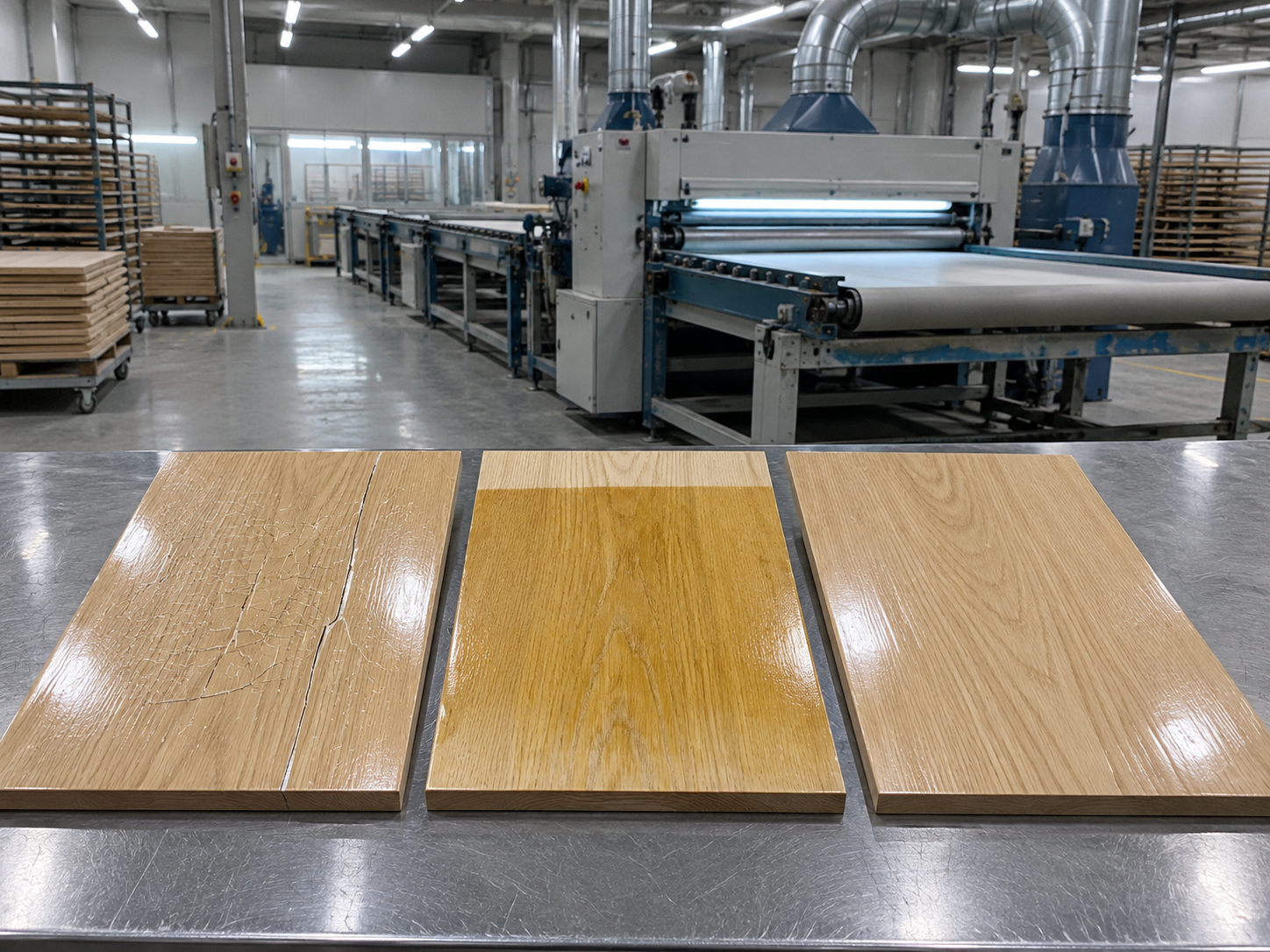
In the primer, a resin with poor filling or an unsuitable film makes the primer hard to sand: the sandpaper clogs, the surface scratches unevenly, and the topcoat then shows sanding marks. In the topcoat, a film that is too hard and brittle tends to crack when the wood shrinks with humidity and temperature changes, and the cracks usually run along the grain or the panel edge. On light woods such as oak, ash and rubberwood, the film yellows after a period of use, most visibly next to uncoated wood or in covered areas. On oily woods, poor adhesion appears because surface oil keeps the film from contacting the wood, and the film peels at edges or on impact.
To see why the resin determines these defects, look at how a UV film forms. A UV coating consists of a film-forming resin (an oligomer carrying acrylate groups), reactive diluent monomers and a photoinitiator. The photoinitiator is a compound that absorbs UV light and generates free radicals. The free radicals link the acrylate groups together, turning the liquid coating into a solid film with a crosslinked network within seconds under the UV lamp.
Because the reaction is fast and has no prolonged evaporation stage, the network structure is fixed right at the conveyor. Film hardness, flexibility and shrinkage are set by the base resin structure and the crosslink density. Adjusting application conditions can hardly make up for a wrongly chosen resin structure, so the resin must be chosen first.
4 criteria for choosing UV curing resin for wood coatings
All four criteria below come from the structure of the film-forming resin.
Role of the coat: primer or topcoat
Primer and topcoat place nearly opposite demands on the resin. The primer must be easy to sand and fill the wood grain well: the film must be hard enough to sand to a fine powder instead of clogging the sandpaper, and the resin must fill well to level pores and grain before topcoating. Clarity matters little in the primer because the topcoat sits above it.
The topcoat is in direct contact with the user, so the film needs scratch resistance and must stay clear so the wood grain shows. Scratch resistance comes from a sufficiently strong network, while clarity depends on the color of the resin and its compatibility with the reactive diluent. A resin chosen for sandability usually does not also deliver the surface durability a topcoat needs, so the two coats often use two different resin families.
Balancing hardness and flexibility
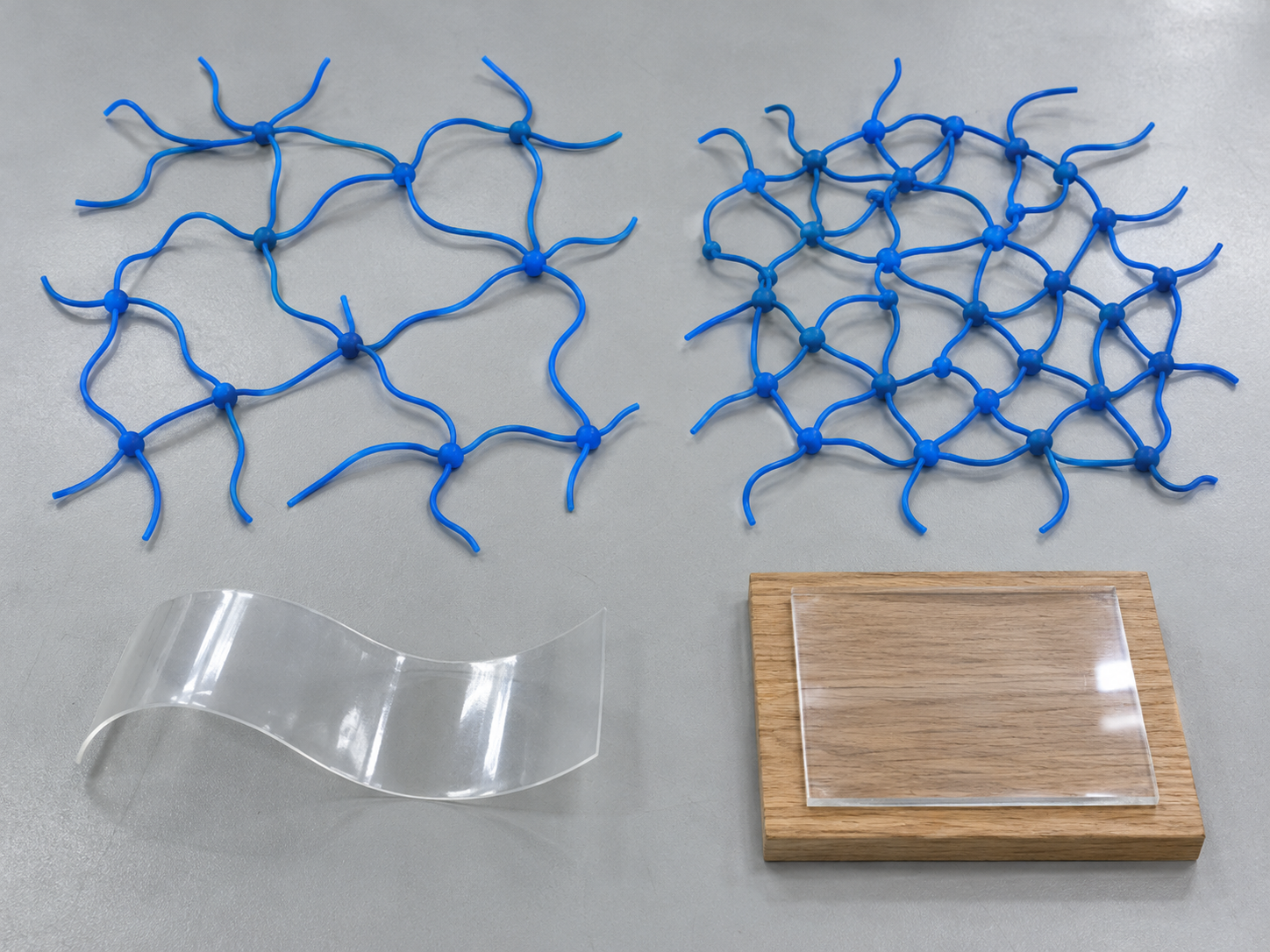
Film hardness in UV systems is tied to the number of acrylate functional groups per resin molecule. Each acrylate group is a point that can join the network during curing. The more functional groups, the higher the crosslink density: the film is harder and more scratch resistant, but also more brittle, with greater volumetric shrinkage as double bonds convert to single bonds. A resin with fewer functional groups gives a looser network and a flexible film that follows the movement of the wood, but it is softer and scratches more easily.
Interior wood expands and contracts with humidity, so a film that is too hard will crack before the wood stabilizes. Shrinkage also creates stress at the interface between film and wood, which contributes to lower adhesion. Functional group count and cured film hardness are both parameters to read on the resin TDS.
Yellowing resistance
Yellowing originates in the chemistry of the resin backbone. Aromatic ring structures in the backbone absorb UV radiation, including the UV present in daylight. The absorbed energy oxidizes certain sites in the chain and forms color-bearing groups, which accumulate with time and heat, so the film yellows slowly. Aliphatic resins, which contain no aromatic rings, absorb less UV and do not form color-bearing groups by this route, so they hold their color better.
Light wood shows this color change clearly, while dark wood masks some of it. The outermost topcoat should prioritize color stability. The primer underneath still shows through a clear topcoat, so it also needs testing on the exact wood in use.
Viscosity and dilution
UV resins are usually viscous, so the formulator must add reactive diluent monomers to reach a flow suited to the application method: roller, spray or curtain. The resin's viscosity determines how much monomer is needed, and that amount carries three consequences. Monomers contribute to odor in the coating film. Multifunctional monomers increase shrinkage. High shrinkage creates stress at the interface and affects adhesion, especially on oily wood.
A lower-viscosity resin needs less monomer. Viscosity is a parameter read on the TDS, and the same resin measured at different temperatures gives different values. Always read the measurement temperature stated on the TDS and compare it with the actual temperature of the coating supply system in your workshop.
How to match UV curing resin to your wood coating line
Step 1 — Define the coat, wood species, wood color and application method (roller, spray, curtain)
Record four data points before comparing any resin: whether the coat under review is a primer or a topcoat; the wood species (oily or low-oil, porous or dense); the wood color (light or dark, which sets the sensitivity to yellowing); and the application method. Roller, spray and curtain each require a different flow, which limits the amount of reactive diluent and the viscosity range you can use. These four data points remove most of the options from the start.
Step 2 — Read the TDS: viscosity, functional group count, film hardness, yellowing behavior
For each candidate resin, read four parameters on the TDS: viscosity (with measurement temperature), functional group count, film hardness and yellowing behavior, then compare them with the four data points from step 1. The TDS reports results measured under the supplier's conditions, so it cannot replace a real trial. Test samples under the exact lamp type used on your line, because lamp emission spectrum and intensity affect the degree of cure, and test on the same wood you produce on.
Step 3 — Narrow down the resin family
Once you have the requirements and the TDS data, narrow the choice by oligomer family:
- Polyurethane acrylate: aimed at topcoats that need a flexible, color-stable film, especially when an aliphatic grade is chosen.
- Epoxy acrylate: aimed at primers that need a hard film and good sandability. This family usually contains aromatic rings, so yellowing must be tested when the primer sits under a clear topcoat on light wood.
- Polyester acrylate: a family that balances the requirements, used when no single property needs to be pushed hard.
- Waterborne UV resin: consider it when VOC needs to be reduced. This system requires a water evaporation stage before the UV lamp, so check that the line has a suitable drying section.
Vichem distributes UV curing resin from the supplier Covestro; the TDS of each type lists the parameters from step 2 so that formulators can compare them themselves.
Common mistakes when choosing UV curing resin for wood coatings
The four mistakes below recur most often when switching to or newly selecting a UV coating system for wood.
The first mistake is using one resin for both primer and topcoat. The primer must sand easily, while the topcoat must resist scratching and stay clear. These two requirements pull the resin structure in different directions, so a single resin rarely meets both.
The second mistake is choosing by hardness and forgetting film shrinkage. The harder the film, the higher the crosslink density, and the shrinkage that comes with it leads to cracking or peeling when the wood expands and contracts. High hardness on the TDS does not mean the film will adhere durably to wood.
The third mistake is not testing on real wood. A glass or metal test panel has none of the oil, porosity or movement of wood, so it cannot reflect adhesion and cracking. Test on the exact wood species you produce on.
The fourth mistake is ignoring yellowing on light wood. A freshly coated film looks acceptable, while yellowing only shows after a period of use, once the goods have been delivered. For light wood, consider the yellowing behavior of the resin from the start and check the backbone structure before approval.
Frequently asked questions
Which UV resin for wood coatings does not yellow?
Aliphatic resins, with no aromatic rings in the main chain, yellow less than resins containing aromatic rings because they absorb less UV. Actual color stability is also affected by the photoinitiator and monomers in the formulation. So test on light-colored wood instead of relying only on the resin family name.
Is cracking in UV wood coatings caused by the resin?
It can be, when the film-forming resin has a high crosslink density that makes the film brittle so it cannot follow the movement of the wood. Other causes include an overly thick coat, wood whose moisture has not stabilized, and overcuring. Check these factors before switching to another resin.
Can waterborne UV resin be used for interior applications?
Yes, a waterborne system suits interior coatings when VOC needs to be reduced. The conditions are that the line has a water evaporation stage before the UV lamp, and that the cured film meets the hardness and scratch resistance requirements when sampled on real wood. Check both conditions before running production.
Conclusion
Choosing UV curing resin for interior wood coatings means matching the resin structure to the requirements of each coat, each wood species and each line. TDS parameters indicate the direction of selection, while a trial on real wood confirms the result.
- Define whether the coat is a primer or a topcoat: the primer must sand easily and fill well, the topcoat must resist scratching and stay clear.
- Balance hardness and flexibility through the number of acrylate functional groups, taking into account shrinkage when the wood expands and contracts.
- Control yellowing through the resin backbone structure, and prioritize aliphatic resins for topcoats on light wood.
- Read viscosity together with the measurement temperature to know the amount of reactive diluent, and the resulting odor, shrinkage and adhesion.
- Test samples on the exact wood species, under the exact lamp type of the line, before approving the resin.
Vichem is a distributor of chemical additives from leading brands such as Covestro, Sinopec and Bühler in the Vietnamese market.
For more information about our products, please contact us through the following channels:
- Hotline: 08 1790 1790
- Zalo OA: Vichem JSC
- Email: contact@vichem.vn
- LinkedIn: Vichem JSC
- Website: www.vichem.vn
- Facebook: Vichem JSC